
Oakland has cut its homicide rate by 52% in just two years. This program deserves credit
San Francisco Chronicle
Learn More about Oakland has cut its homicide rate by 52% in just two years. This program deserves credit



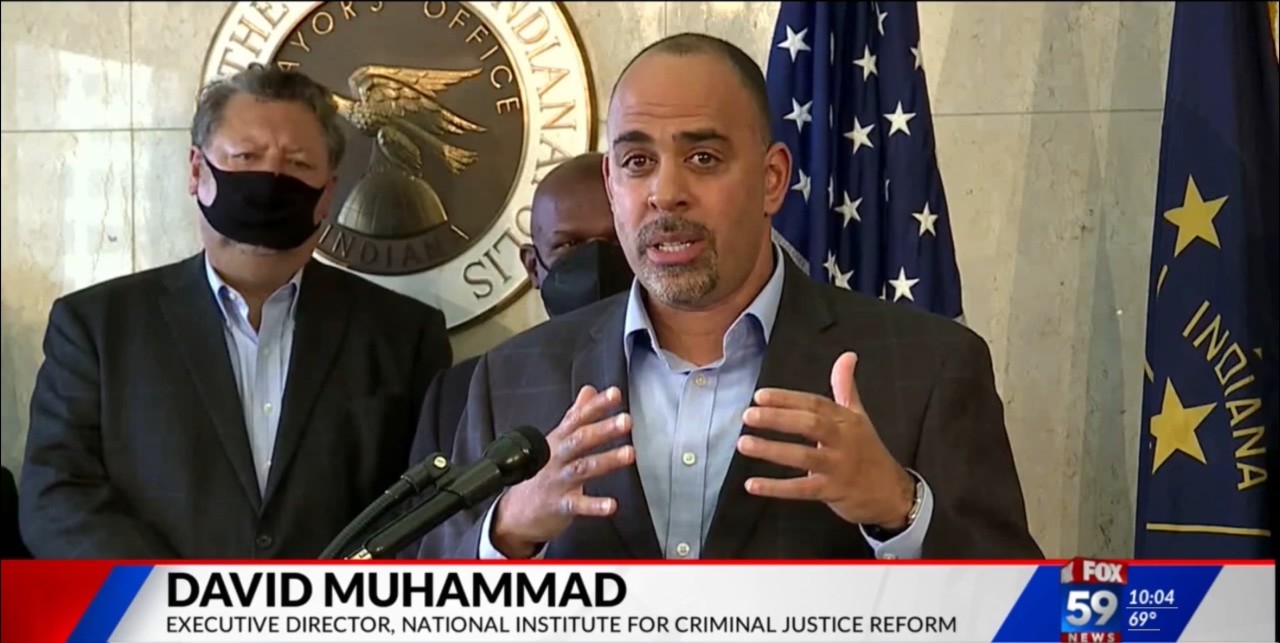
David Muhammad is a leader in the fields of violence reduction, youth development, and criminal justice reform. David is the Executive Director of the National Institute for Criminal Justice Reform (NICJR).
Through NICJR, David provides leadership and technical assistance to gun violence reduction strategies (GVRS) in cities across the country. In Oakland, David helped lead a partnership of organizations and technical assistance providers that achieved a 50% reduction in shootings and homicides. NICJR’s work in Oakland and David’s own experiences as a justice-involved youth in the city were profiled in the New York Times Magazine in January 2025. In Indianapolis, David led the NICJR team that worked with the City to implement the successful Indianapolis Gun Violence Reduction Strategy. In the first three years after the launch of GVRS (through the end of 2024), Indianapolis saw a 29% reduction in murders and nonfatal shootings.
David also helped lead development of the national CVI Action Plan, which set out a groundbreaking, community-led vision for the field of community violence intervention.
David’s prior experience leading nonprofit organizations includes serving as the first Executive Director of the Anti-Recidivism Coalition (ARC) in Los Angeles. ARC has grown to become one of the largest and most prominent service providers and policy advocacy organizations for the formerly incarcerated in California. He also previously served as Executive Director of The Mentoring Center in Oakland. During his tenure there, David was contracted by the City of Richmond, CA, to help design the Office of Neighborhood Safety, which has since been credited with bringing significant violence reductions to the city.
David has worked to implement positive youth development into youth justice systems around the country. For three years, he was extensively involved in developing a detailed reform plan for the Los Angeles County Probation Department, the largest probation department in the country. He also served as the technical assistance provider for the Sierra Health Foundation’s Positive Youth Justice Initiative, providing training and consulting to several California probation departments. More recently, David led NICJR’s detailed assessment of Hawaii’s system of care for justice-involved youth and developed recommendations to support the State’s continued system reform. He also led NICJR’s collaboration with the Maryland Department of Juvenile Services to develop and implement a gun violence reduction strategy for the state’s system-involved youth, resulting in the launch of the Thrive Academy.
David has also supported justice system reform as a monitor in several jurisdictions. He was the federal court appointed monitor overseeing reforms in the Illinois juvenile justice system in the MH v. Monreal Consent Decree. He was also the federal monitor in the Morales Settlement Agreement, which requires the Illinois Parole Review Board and the Illinois Department of Corrections to reform its parole system. In addition, for six years David was a member of the Antelope Valley Monitoring Team, which is charged with monitoring the Los Angeles Sheriff's Department’s implementation of a federal Settlement Agreement. He has also served as an expert witness in numerous juvenile and criminal justice federal lawsuits.
David’s approach to justice reform is informed by his time leading justice agencies. As Chief Probation Officer of the Alameda County, California, Probation Department, he was responsible for overseeing 20,000 people on probation, a staff of 600, and a $90 million budget. In 2010, David was named Deputy Commissioner of the Department of Probation in New York City, the second largest Probation Department in the country, where he was responsible for overseeing 35,000 people on probation and a staff of 900. David also served as the Chief of Committed Services for the Washington, DC, Department of Youth Rehabilitation Services (DYRS). His responsibilities at DYRS included 300 staff, a $42 million annual budget, a juvenile institution, and 900 youth committed to DYRS care.
A graduate of Howard University’s School of Communications, David has an extensive journalism career and has authored numerous op-ed articles in prominent media outlets, including the Washington Post, LA Times, Baltimore Sun, Philadelphia Inquirer, San Francisco Chronicle, Sacramento Bee, and many others. David also completed a course on “Systems Dynamics for Senior Managers” at the MIT Sloan School of Management in Cambridge, MA. In August of 2008, David completed a certificate program on Juvenile Justice Multi-System Integration at the Georgetown Public Policy Institute.